
The brief
HGS Farms (HGS Khanewal Farms) is a livestock and agriculture agribusiness. It wanted a professional public presence for customers, investors and partners and, in the same system, one place to run people, documents, events, purchasing, livestock and money instead of spreadsheets. Staff had to be able to change the website without a developer, and the right people had to see the right records, no more.
hgsfarms.com
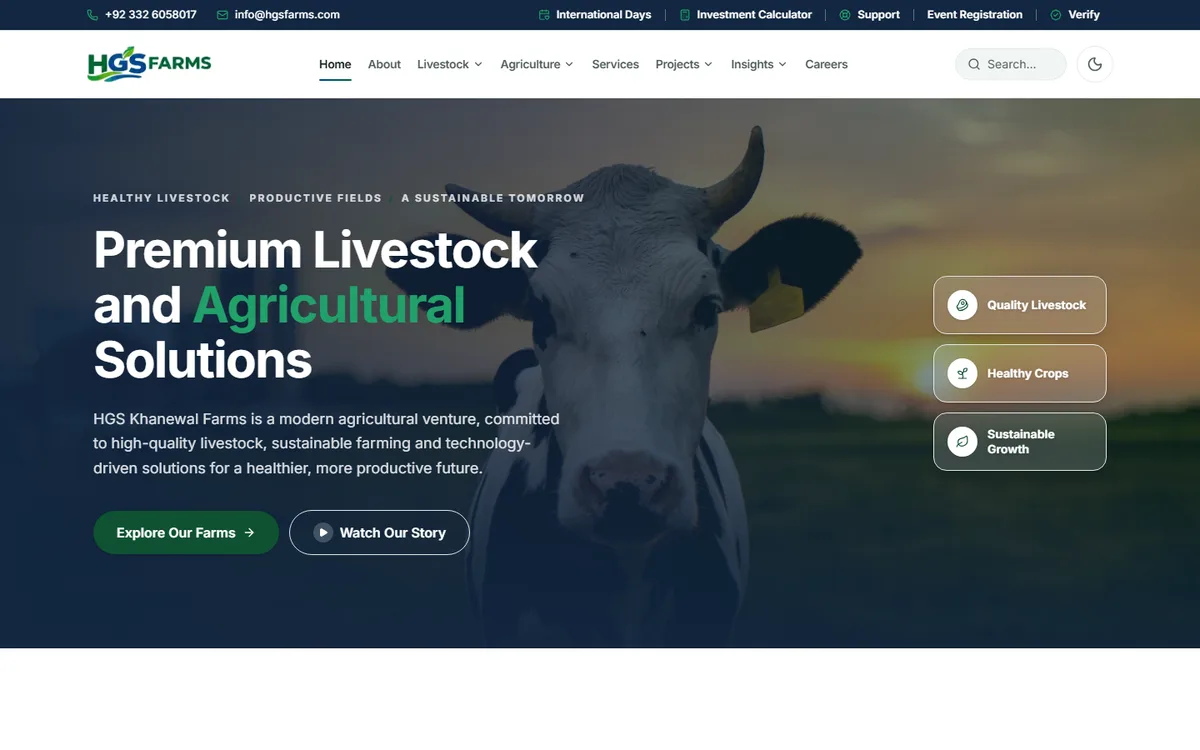
The live website
HGS Farms
What we built for the website
- A corporate website for the farm's services, projects, insights, events and frequently asked questions, with a page builder so every page can be edited.
- Insights: articles with categories, search and sorting, and comments with replies that the team moderates.
- Events and participants: event pages with a Register button, a sign-up journey, a waiting list and volunteering, and support for international participants, including visa support letters.
- An investment calculator that gives an estimate with a clear disclaimer, and an International Days page.
- Web Stories: genuine AMP stories, each checked with the official AMP validator before it can be published.
- Verification: a public page where a document number or QR code shows whether an invoice, letter, certificate or salary slip is genuine, without exposing amounts or personal details.
- Urdu support in the editor, with several ways to type Urdu, and fonts chosen for it.
What we built for the dashboard
- Website management: a media library that controls what is public and shows where each file is used, navigation menus, automatic redirects when an address changes, an announcement bar, a video gallery, a homepage editor, draft-to-review-to-publish with version history, SEO health checks, brand and letterhead, and rules for which uploads are accepted. Uploads are checked by their real content, not only their name.
- Roles and access: roles are data, not code. Twenty-one starter roles follow the organisation chart, a person can hold several roles, data can be limited to all, department or own records, approvals have limits and keep duties separate, and every change is audited.
- People: staff directory, documents, onboarding, leave, payroll, positions and the organisation chart, and recruitment.
- Sales and money: customers, quotations, invoices and payments with PDF output, purchases and suppliers, expenses and financial reports.
- Farm operations: inventory and livestock records, with project pages that total the animals and expenses for each project.
- Documents: a library where a new file is private until it is shared, with versions and reminders before documents expire.
- Enquiries and email: a shared inbox where the team replies from the farm's own mailbox, with a record of any message that could not be delivered.
- Portals: separate sign-ins for staff, investors, customers and event participants.
- Exports and printing to Excel, PDF and CSV, each gated by its own permission.
Engineering notes
Every protected route must declare its permission, and an automated check reports any route that does not. Because the host has no scheduler or CI, scheduled jobs are triggered through the control panel's cron calls to protected endpoints, with in-app fallbacks so nothing is lost if a job is never configured.